TL;DR:
- Proper drainage gravel must have high void ratios and permeability for effective water flow.
- Angular crushed gravel Interlocks and offers stability, ideal for French drains and retaining walls.
- Sourcing clean, graded gravel and avoiding shortcuts are essential for long-lasting drainage systems in Atlanta.
Not all gravel drains water effectively, and that misunderstanding costs Atlanta homeowners and contractors thousands of dollars every year. Using the wrong material in a French drain, under a retaining wall, or beneath a driveway base can lead to standing water, foundation damage, and expensive repairs. Atlanta’s red clay soil and intense summer rain events make the stakes even higher than in most parts of the country. This guide breaks down what drainage gravel is, how shape and size determine performance, how common types compare, and exactly how to choose the right material for your specific project.
| Point | Details |
|---|---|
| Drainage gravel matters | Choosing the right drainage gravel protects landscapes and buildings from water damage. |
| Shape and size are critical | Angular, well-graded stone like #57 outperforms rounded gravels for drainage and stability. |
| Layering prevents clogs | Using multiple gravel sizes and adding filter fabrics keeps systems free-flowing. |
| Over-compaction reduces drainage | Only lightly compact open-graded gravel or risk flooding from blocked voids. |
| Local advice ensures success | Sourcing from experienced Atlanta suppliers tailors projects to climate and soil. |
Drainage gravel is not just any crushed rock. It is stone specifically selected to allow water to move through it rapidly, preventing water from building up beneath surfaces, around foundations, or behind retaining walls. The goal is to create a permeable layer that guides water away from structures before it can cause erosion, flooding, or structural damage.
Two technical concepts explain why certain gravels work and others fail. The first is void ratio, which refers to the percentage of empty space between stone particles. Higher void ratios mean more room for water to move. The second is permeability, which describes how quickly water can pass through the material. Both factors depend heavily on stone shape, size, and how tightly the material is packed.
Here is where selecting gravel for landscaping decisions become critical. Angular crushed gravel interlocks for stability under load while maintaining 30 to 45% void ratios for water flow. Rounded stones, by contrast, pack together more tightly, reducing those critical air spaces.
Drainage gravel is used in a wide range of applications across Atlanta projects:
Choosing drainage gravel is not about picking the cheapest rock. It is about matching the material’s physical properties to the specific demands of your site, your soil, and your climate.
Atlanta’s soils present a particular challenge. Red clay is notoriously slow-draining and expands when wet, creating pressure against foundations and hardscape elements. A well-selected drainage gravel layer acts as a buffer, intercepting water before it saturates the clay and causes movement.
Understanding how drainage gravel works sets the stage for choosing between the main types. In the field, two broad categories dominate: angular crushed gravel and rounded gravel like pea gravel. Each performs very differently, and using the wrong one in the wrong place is one of the most common mistakes we see on Atlanta job sites.
| Property | Angular crushed gravel | Rounded pea gravel |
|---|---|---|
| Particle shape | Jagged, irregular edges | Smooth, rounded surface |
| Interlocking ability | High | Low |
| Void ratio | 30 to 45% | Lower due to tighter packing |
| Drainage speed | Rapid | Slower |
| Stability under load | Excellent | Poor |
| Best use | French drains, sub-bases, retaining walls | Light decorative use |
| Risk of shifting | Low | High |
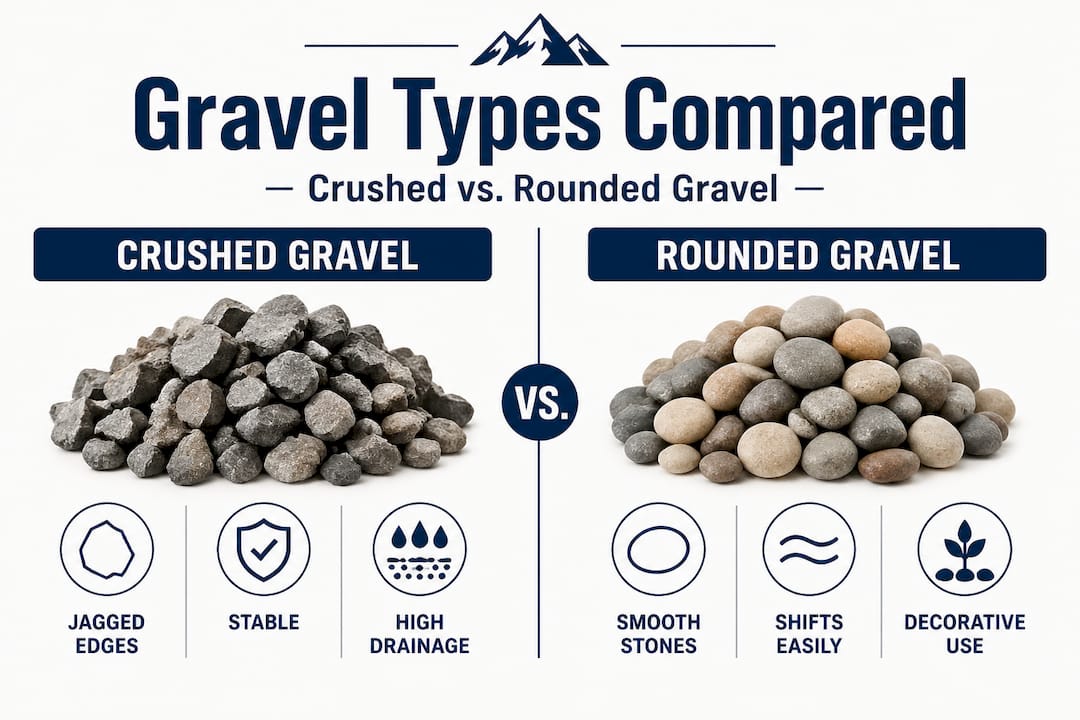
Angular crushed gravel interlocks for stability under load while maintaining those critical void ratios; rounded pea gravel drains slower and shifts more, making it suitable only for light-duty decorative uses. That distinction matters enormously when you are building a system that needs to handle Atlanta’s heavy rain events reliably over years.
Angular crushed gravel is the workhorse of drainage projects. Its jagged edges cause each piece to lock against neighboring stones, which keeps the layer stable even under traffic or soil pressure. At the same time, those irregular shapes create generous air pockets that water can move through freely. This combination of stability and permeability is exactly what a French drain or retaining wall backfill demands.
Rounded pea gravel is visually appealing and comfortable underfoot, which makes it popular for pathways and decorative beds. However, its smooth surface means particles slide past each other easily. Under load, the layer shifts and compresses, crushing the void spaces that make drainage possible. Learn more about pea gravel pros and cons before specifying it for any project that involves water management.
Pro Tip: If a client or homeowner insists on the look of pea gravel near a drainage area, install a proper angular gravel drainage layer beneath it and reserve the pea gravel strictly for the top decorative inch. Never rely on it for structural drainage function.
For most functional drainage work in Atlanta, using #57 stone gravel is a proven starting point. It is angular, consistently sized, and widely available from local suppliers.
Now that you know the main stone shapes, the next step is understanding how specific grades and sizes determine how well your drainage system performs. Gravel is classified by number grades set by the American Association of State Highway and Transportation Officials. Smaller numbers indicate larger stone sizes, which can seem counterintuitive at first.
| Grade | Approximate size | Primary drainage use |
|---|---|---|
| #3 | 1.5 to 2 inches | Heavy drainage, riprap |
| #57 | 0.5 to 1 inch | French drains, sub-bases |
| #67 | 0.75 inch and under | High-performance drainage |
| #89 | 0.375 inch | Pipe bedding, fine filter layers |
#67, which is dust-free and under 1 inch, is superior to #57 for maximum drainage; layering different sizes creates a filtration effect that extends system life. That layering approach is one of the most important installation details that separates lasting systems from ones that fail within a few seasons.
Void ratios of 35 to 45% for #3 and #57 stone represent the sweet spot for drainage performance. #57 stone delivers optimal permeability without clogging perforated pipes, which is why it dominates most French drain specifications across the Atlanta metro area.
Here is a step-by-step approach to grading your drainage layers for best results:
Check out specific #57 stone construction uses for project-specific guidance, and review driveway gravel layering tips if your project involves a driveway base. Atlanta’s freeze-thaw cycles, while mild compared to northern states, still stress improperly layered sub-bases during winter months.
After learning the technical details, avoiding the pitfalls that can undermine everything becomes the priority. In our experience supplying materials across the Atlanta metro area, the most expensive drainage failures share common causes.
Here are the mistakes we see most often:
The most expensive drainage repair we see is one that could have been avoided at the material selection stage. The gravel itself is often the least costly part of a drainage system. Shortcuts there never save money in the long run.
Pro Tip: Before installation, ask your supplier for a gradation report on any drainage gravel. This document shows the distribution of particle sizes and confirms the material is clean and open-graded, not contaminated with fines.
Review these gravel installation tips before beginning any drainage project. When in doubt, consulting a local Atlanta landscape supply specialist before purchasing can prevent a costly mistake.
Equipped with knowledge of types, grades, and pitfalls, you are ready to make the best choice for your Atlanta drainage project. The process is straightforward when you follow a structured approach.
Explore local gravel choices tailored to Atlanta projects to compare options side by side. For complex or large-scale drainage work, reviewing exterior drainage system strategies can provide a broader framework for combining gravel selection with overall system design.
Most drainage gravel guides treat the topic as though all U.S. sites are similar. They are not, and Atlanta is a strong example of why that assumption fails. We work with homeowners and contractors across Marietta, Smyrna, and the broader Atlanta metro every season, and the patterns in drainage failures are remarkably consistent.
Atlanta receives an average of 50 inches of rain per year, much of it arriving in intense bursts rather than slow soaking events. That means your drainage gravel needs to move large volumes of water quickly, not just allow gradual seepage. Standard recommendations from national guides often underestimate the flow rates that Georgia properties must handle.
The deeper issue involves the combination of heavy rain and red clay subsoil. Clay expands when saturated, creating upward pressure against slabs and lateral pressure against walls. A drainage layer that works adequately in sandy Mid-Atlantic soils may perform poorly when surrounded by Atlanta’s expansive clay. That is why we consistently recommend upsizing your gravel grade, adding a dedicated filter fabric layer, and never skipping the geotextile step to save budget.
In our observation, the majority of drainage system failures we encounter involve not the cost of the material itself, but shortcuts in installation planning and sourcing advice. Contractors who buy from unfamiliar suppliers sometimes receive material with higher fines content than specified, effectively receiving a product with void ratios far below what the project requires. Sourcing from a trusted local supplier who knows what Georgia projects demand is not just a convenience. It is a quality control step.
Our recommendation is simple: treat gravel selection and system design as connected decisions, not separate ones. A thorough approach to gravel selection addresses both material properties and installation methods together, and that is the approach that produces systems lasting 20 or more years in Atlanta’s climate.
Making the right material choice is only half of the equation. The other half is sourcing it from a supplier who understands Atlanta’s climate, local soil conditions, and project demands.

At Mountain High Landscape Supply, we stock premium drainage gravel grades including #57 stone, #67 stone, and specialty blends for complex applications, all available from our clean and well-organized yards in Marietta and Smyrna. Our team works directly with homeowners and professional contractors to match the right material to each project. We offer flexible pickup options at both locations and reliable bulk delivery throughout the Atlanta metro area. Browse our full selection of Atlanta’s top-rated landscape materials and consult our detailed Atlanta supply guide to plan your project with confidence. We are here to help you get it right the first time.
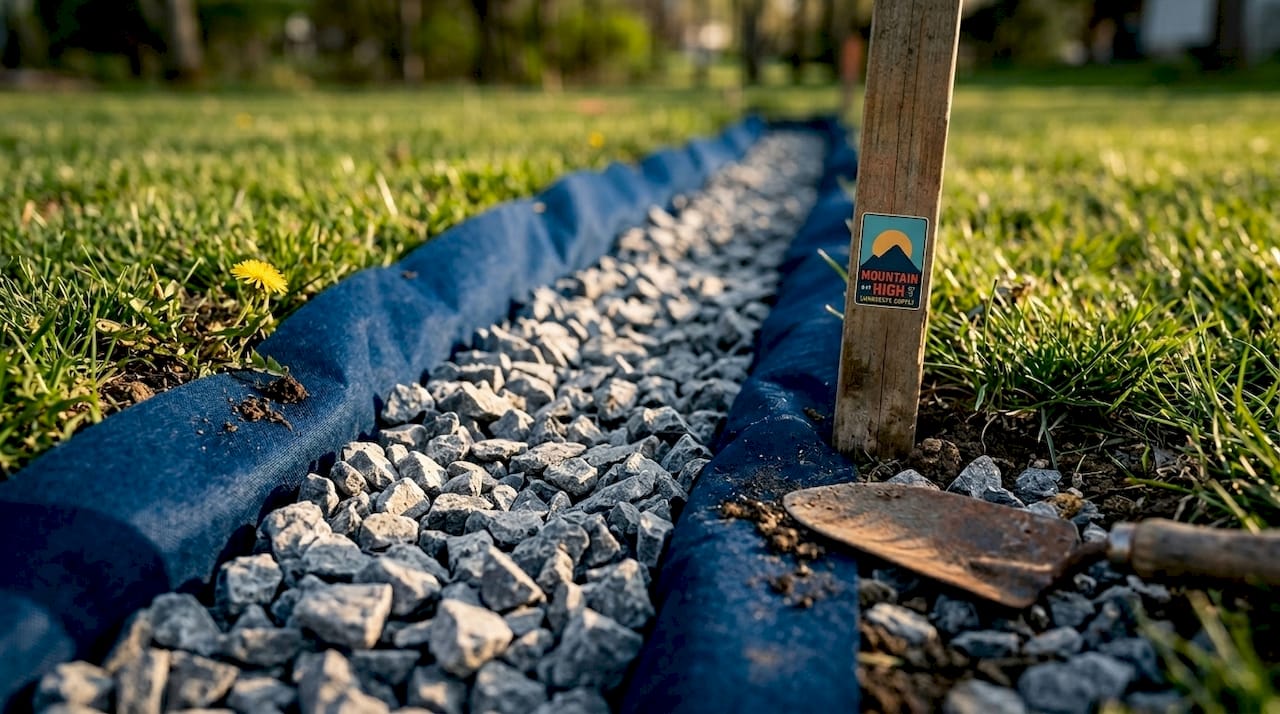
#57 stone delivers optimal permeability without clogging pipes, making it the standard choice for French drains across the Atlanta metro. Its angular shape and consistent sizing allow water to enter the perforated pipe quickly and move efficiently through the system.
Rounded pea gravel drains slower and shifts more, making it unsuitable for driveway drainage applications where load stability and rapid water movement are both required. Reserve pea gravel for light decorative uses only.
Over-compaction of open-graded stone reduces voids and defeats the drainage function. Place drainage gravel firmly but avoid mechanical compaction to high density; the material should remain loose and permeable.
Yes, especially in Atlanta where red clay soils migrate aggressively into gravel layers over time, progressively clogging the system. Geotextile filter fabric placed between native soil and your gravel layer is one of the most cost-effective ways to protect long-term drainage performance.
#67 is dust-free and under 1 inch, making it superior for maximum drainage in demanding applications. #57 is slightly larger and is the most widely used grade for French drains and general sub-base drainage work across Georgia.