Ordering mulch for your Atlanta landscaping project should be straightforward, but confusing terminology often leads to costly mistakes. Homeowners and professional landscapers alike struggle with measurements like cubic yards versus cubic feet, shred types, and application depths. These misunderstandings result in ordering too much or too little material, choosing the wrong mulch type for your soil conditions, and wasting time on returns or additional deliveries. This guide clarifies essential mulch supply terms so you can confidently plan, order, and apply mulch for beautiful, healthy landscapes across Atlanta, Marietta, and Smyrna.
| Point | Details |
|---|---|
| Bulk mulch is measured in cubic yards | One cubic yard equals 27 cubic feet and covers approximately 108 square feet at 3 inches deep. |
| Shredded mulch comes in three processing levels | Single, double, and triple shredded varieties offer different particle sizes affecting decomposition rate and weed control. |
| Atlanta-specific mulches include pine straw and bark | Pine straw costs $5 – 7 per bale while wood mulch runs $30 -48 per cubic yard, each suited to different soil types. |
| Apply mulch 2-3 inches deep for best results | This depth provides up to 90% weed suppression and reduces moisture evaporation by 25-50%. |
| Proper placement protects plants | Keep mulch 3-6 inches away from plant stems and crowns to prevent rot and pest problems. |
Grasping volume measurements prevents ordering errors and saves money on your landscaping projects. Bulk mulch is measured in cubic yards, with 1 cubic yard equaling 27 cubic feet and covering about 108 square feet at 3 inches deep. Bagged mulch typically comes in 2 cubic foot units, making conversion essential when comparing bulk versus bagged pricing.
Calculating your mulch needs requires a simple formula: multiply your bed’s square footage by the desired depth in inches, then divide by 324 to get cubic yards needed. For example, a 108 square foot bed at 3 inches deep requires exactly 1 cubic yard of mulch. A mulch calculator guide can verify your math and prevent costly overordering.
Bulk versus bagged mulch comparison:
Bulk mulch becomes more economical when your project exceeds a few cubic yards, but you’ll need to coordinate delivery logistics. Pro Tip: Confirm minimum bulk order requirements and delivery fees with suppliers before committing, as Atlanta area providers have varying policies on small loads and accessibility to tight spaces.
Understanding the mulch delivery workflow in Atlanta helps you prepare your site for efficient unloading. Suppliers need clear access paths, level ground for dumping, and advance notice about any site restrictions like narrow driveways or overhead power lines.
| Measurement | Cubic Feet | Square Feet Covered (3″ deep) |
|---|---|---|
| 1 cubic yard | 27 | 108 |
| 1 bag (standard) | 2 | 8 |
| 5 cubic yards | 135 | 540 |
Measurement precision matters because shortages delay projects while excess material creates disposal headaches. Always add 5-10% extra to your calculated amount to account for settling, uneven application, and bed edge spillage during spreading.
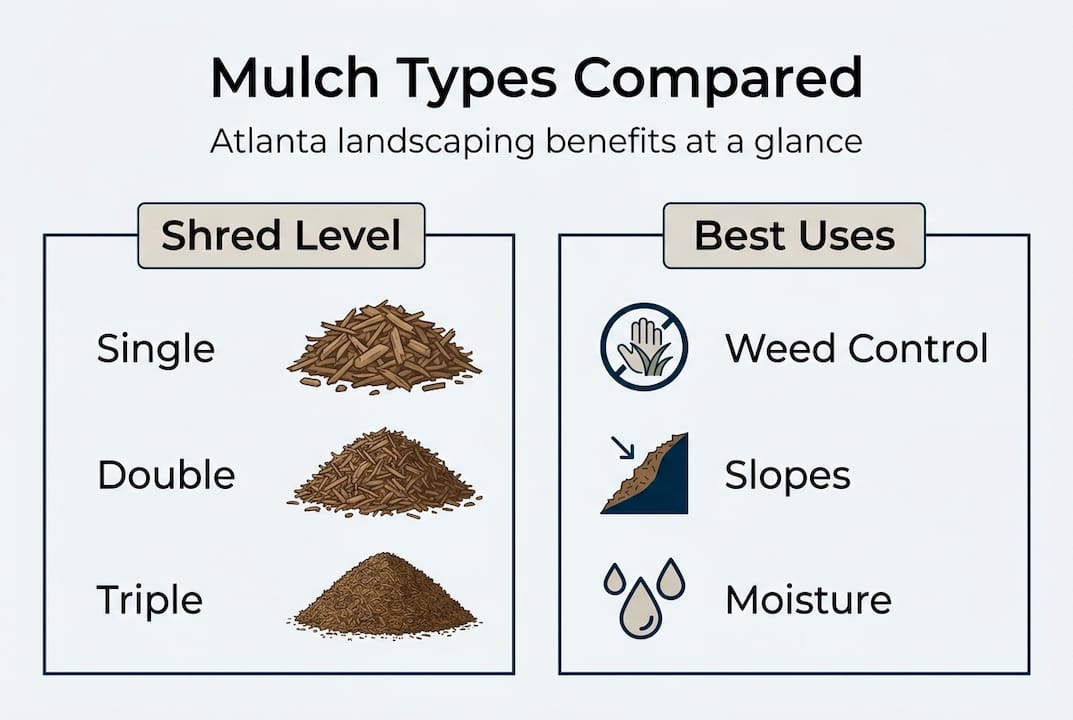
Shredded mulch processing levels dramatically affect performance, longevity, and maintenance requirements in your landscape beds. Single shredded mulch features coarse, chunky particles from one pass through industrial shredders, creating pieces roughly 1-3 inches in size. This texture resists decomposition longer but allows more weed penetration and water runoff on slopes.
Double shredded mulch is finer, processed twice, with uniform particles offering better weed control and moisture retention. The smaller particle size creates a denser mat that blocks sunlight more effectively while holding water near plant roots. However, this finer texture decomposes faster, requiring more frequent refreshing than single shredded varieties.
Triple shredded mulch represents the finest processing level, with particles resembling coarse sawdust or small chips. This ultra-fine texture decomposes quickest, making it ideal when you want rapid soil amendment and nutrient release. The fast breakdown means you’ll refresh this mulch more often, but it integrates beautifully into existing soil structure.
Shredded mulch comparison:
| Shred Type | Particle Size | Decomposition Rate | Weed Control | Best Uses |
|---|---|---|---|---|
| Single | 1-3 inches | Slow (2-3 years) | Moderate | Slopes, pathways, low-maintenance areas |
| Double | 1/4-1/2 inch | Medium (1-2 years) | Excellent | Garden beds, around shrubs, general landscaping |
| Triple | Under 1/4 inch | Fast (6-12 months) | Superior | Vegetable gardens, annual beds, soil building |
Choosing the right shred type depends on your maintenance schedule and landscape goals. Explore shredded mulch types expert guide for detailed regional recommendations based on Atlanta’s clay soils and humid climate.
Pro Tip: Select double or triple shredded mulch for slopes steeper than 15 degrees, as the finer particles interlock better and resist washing away during Georgia’s heavy spring rains. Single shredded mulch tends to slide downhill, creating bare spots and erosion channels.
The benefits of double shredded mulch include superior moisture retention and a more polished appearance that appeals to homeowners focused on curb appeal. Professional landscapers often prefer double shredded for client properties requiring minimal maintenance between service visits.
Atlanta’s clay soils and humid subtropical climate favor specific mulch types that perform reliably across seasons. Pine straw, harvested from longleaf and slash pines, offers natural acidity that benefits azaleas, camellias, and other acid-loving plants common in Georgia landscapes. Pine straw is natural, acidic, slope-resistant and commonly used in Atlanta, priced $5-7 per bale covering 50 square feet, while wood mulch costs $30-48 per cubic yard.
Pine bark mulch resists compaction better than hardwood varieties, maintaining air pockets that promote root health in Atlanta’s heavy clay. This durability makes pine bark ideal for high traffic areas and beds around trees where you want long-lasting coverage. The reddish-brown color complements brick homes prevalent throughout Marietta and Smyrna neighborhoods.
Hardwood mulch, typically from oak or mixed deciduous trees, breaks down faster than pine products but improves clay soil structure more effectively. The decomposition releases nutrients and organic matter that gradually transform dense clay into more workable garden soil. Consider hardwood mulch for vegetable gardens and annual beds where soil improvement outweighs longevity concerns.
Common Atlanta mulch types:
Optimal mulch application depth is 2-3 inches for up to 90% weed suppression and 25-50% less moisture evaporation, with annual refreshing of 1 inch maintaining effectiveness. Deeper applications waste material and can suffocate plant roots by restricting oxygen exchange. Shallower coverage allows weeds to penetrate and reduces moisture retention benefits.
Refreshing mulch annually keeps beds looking sharp and maintains weed control effectiveness. Simply add about 1 inch of new mulch over the existing layer each spring, as the old mulch will have partially decomposed and settled. This approach builds soil health over time while avoiding excessive depth that harms plants.
Proper mulch application steps:
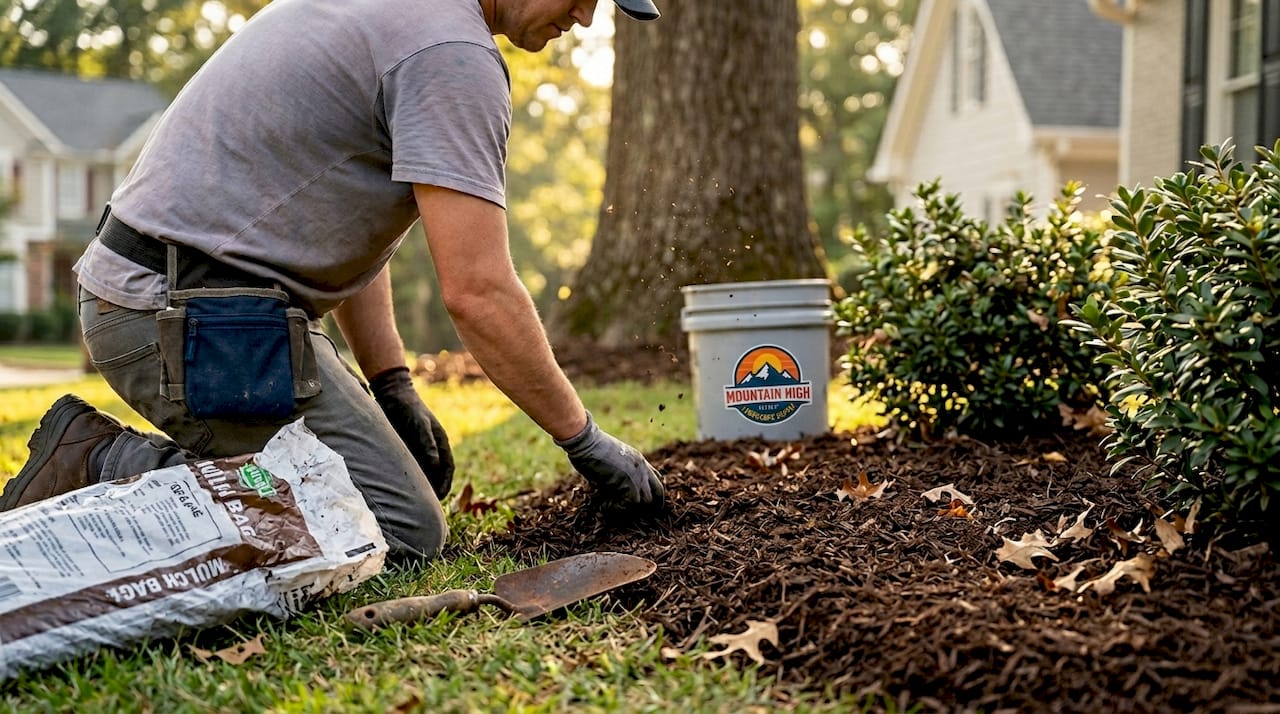
Avoiding mulch volcanoes around tree trunks prevents serious damage that shortens tree lifespan. Piling mulch against bark creates constantly moist conditions that invite fungal diseases, insect infestations, and root rot.
Keep mulch pulled back from tree trunks and shrub crowns by at least 3-6 inches, creating a donut shape rather than a volcano. This simple practice prevents 80% of mulch-related plant health problems in Atlanta landscapes.
Explore natural mulch options for organic choices that enhance soil biology, or consider premium pine straw in Atlanta for traditional Southern landscape aesthetics. Brown mulch characteristics complement most architectural styles while providing reliable weed control and moisture management.
Now that you understand mulch terminology and application best practices, sourcing quality materials locally streamlines your project execution. Mountain High Landscape and Hardscape Supply offers comprehensive mulch selections suited to Atlanta’s soil conditions and aesthetic preferences, from natural mulch products to vibrant red mulch selection that enhances curb appeal.

Our expert team helps homeowners and professional landscapers choose the right mulch type, calculate accurate quantities, and coordinate efficient delivery across Atlanta, Marietta, and Smyrna. We maintain clean, organized supply yards where you can inspect materials before purchasing, ensuring you get exactly what your project requires.
Mountain High mulch advantages:
Whether you need bulk delivery for large commercial projects or a few bags for residential touchups, our flexible ordering accommodates every scale. Explore our mulch delivery services in Atlanta to understand how we make material sourcing effortless, letting you focus on creating beautiful outdoor spaces.
Bulk mulch is sold by cubic yard volume and delivered loose or in large quantities, typically more economical for projects exceeding 2-3 cubic yards. Bagged mulch comes in pre-measured 2 cubic foot bags convenient for small jobs, touchups, and easy transport in personal vehicles. Bulk becomes cost-effective when you need roughly 14 or more bags, as delivery fees offset the lower per-unit price.
Multiply your bed’s square footage by desired depth in inches, then divide by 324 to get cubic yards needed. For example, 200 square feet at 3 inches deep equals 1.85 cubic yards, so order 2 cubic yards to account for settling and uneven application. Always add 5-10% extra to your calculation for waste and coverage gaps. Refer to the landscape supply terminology guide for additional measurement conversions.
Pine straw consists of dried pine needles that create a lightweight, acidic mulch ideal for slopes and acid-loving plants, priced around $3-5 per bale. Pine bark mulch is shredded or chipped tree bark that resists compaction, lasts longer than pine straw, and costs $25-40 per cubic yard in bulk. Pine straw requires more frequent replacement but installs faster, while pine bark provides superior weed control and durability.
Refresh mulch annually by adding 1 inch of new material over existing layers each spring, as Atlanta’s humidity and heat accelerate decomposition. Pine bark and hardwood mulches typically need refreshing every 12-18 months, while pine straw requires replacement every 6-12 months due to faster breakdown. Monitor bed appearance and weed emergence as indicators that refreshing is overdue.
Yes, piling mulch against plant stems and tree trunks traps moisture that causes crown rot, bark decay, and fungal diseases that can kill plants within one growing season. Excessive mulch depth over 4 inches suffocates roots by restricting oxygen exchange, while fresh wood mulch can temporarily tie up soil nitrogen during decomposition. Always maintain 3-6 inch clearance from plant crowns and limit depth to 2-3 inches for healthy landscapes.